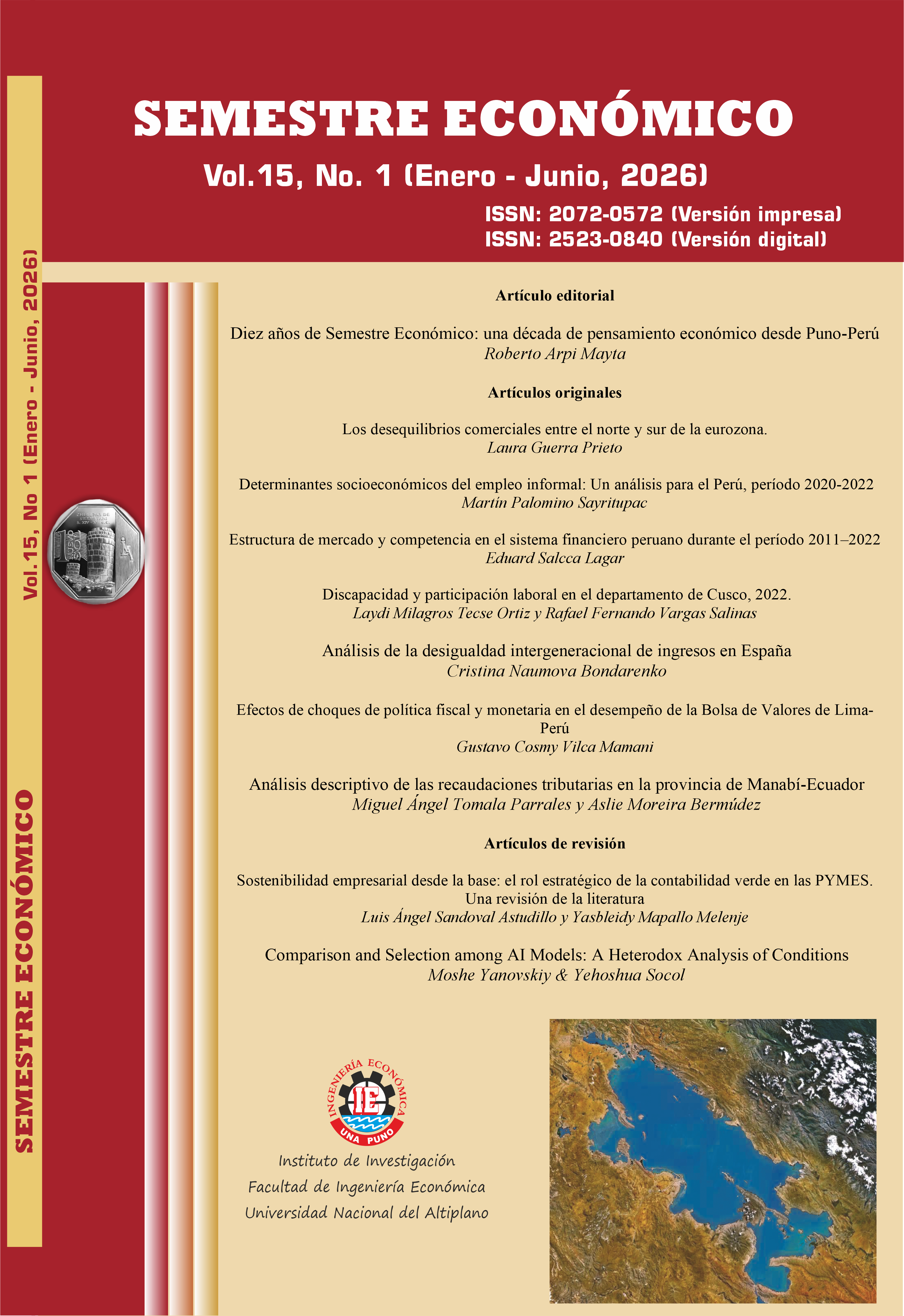
Comparación y selección de modelos de IA: un análisis heterodoxo de las condiciones
DOI:
https://doi.org/10.26867/se.2026.v15i1.205Palabras clave:
Inteligencia artificial, transparencia, sostenibilidad, dilema de caja negra, sesgos y riesgos, enfoques heterodoxosResumen
Revisión heterodoxa sobre el desarrollo en la implementación cotidiana de los algoritmos de inteligencia artificial, sus sesgos y riesgos para la vida humana por falta de transparencia o efecto caja negra. Se centra la atención aquí en la evaluación de un problema que ha influido en el desarrollo de la inteligencia artificial, como es el dilema ético-económico de caja negra, junto con su paradoja. La atención a dicho problema, sobre si prima la transparencia sobre el rendimiento algorítmico (y cómo se valora, con sus sesgos y riesgos), permite comprender la paradoja conducente a la actual dicotomía entre el mundo anglosajón y el europeo continental. Mediante un estudio bibliométrico-narrativo y crítico-hermenéutico, junto con los marcos teóricos y metodológicos de la Escuela Austriaca y los neoinstitucionalistas (dada su experiencia en el análisis de otras cajas negras, como el Estado, el sector público o la economía de bienestar), desde este trabajo se ofrece una exposición y explicación del problema, su alcance y si cabe esperar una futura convergencia de posiciones al respecto.
Referencias
Alonso MA, Sánchez-Bayón A & Gallego-Morales D (2024). Enhancing Visual Literacy and Data Analysis Skills in Macroeconomics Education: A Beveridge Curve Analysis Using FRED® Data. In: Valls Martínez M & Montero J (eds) Teaching Innovations in Economics. Springer, Cham., p. 51-76 https://doi.org/10.1007/978-3-031-72549-4_3
Al-Rashaida M, Moustafa A, Mohsen W (…) & Khan A (2025). AI Strategies for Inclusive Education Resources and Support, AI in Learning, Educational Leadership, and Special Education, p. 349-380. 10.4018/979-8-3373-0573-8.ch012.
Ammar A (2025). systematic and bibliometric review of artificial intelligence in sustainable education: Current trends and future research directions, Sustainable Futures, 10, 101033. DOI: 10.1016/j.sftr.2025.101033.
Andreeva O, Ivanov V, Nesterov A & Trubnikova T (2019). Facial Recognition Technologies in Criminal Proceedings: Problems of Grounds for the Legal Regulation of Using Artificial Intelligence. Tomsk State University Journal 449: 201–212.
Awad E, Dsouza S, Kim R (…) & Rahwan I (2018). The Moral Machine Experiment. Nature, 563: 59–64. http://dx.doi.org/10.1038/s41586-018-0637-6
Benkler Y (2019). Don’t let industry write the rules for AI. Nature 569:161.
Biller-Andorno N & Biller A (2019). Algorithm-Aided Prediction of Patient Preferences - An Ethics Sneak Peek. New England Journal of Medicine, 381(15):1480-1485. https://doi.org/10.1056/NEJMms1904869
Boettke P (2000). Socialism and the market: The socialist calculation debate re-visited. London: Routledge.
Bollerman M (2025). Digital Sovereigns Big Tech and Nation-State Influence. arXiv preprint arXiv:2507.21066.
Buragohain D & Chaudhary S (2025). Navigating ChatGPT in ASEAN Higher Education: Ethical and Pedagogical Perspectives, Computer Applications in Engineering Education, 33(4). 10.1002/cae.70062.
Cath C (2018). Governing artificial intelligence: ethical, legal and technical opportunities and challenges. Phil. Trans. R. Soc. A.37620180080. http://doi.org/10.1098/rsta.2018.0080
Challoumis C (2024). Charting the course-The impact of AI on global economic cycles. In XVI International Scientific Conference. Copenhagen: ISG Konf. (pp. 103-127).
Chaudhary G (2024). Unveiling the black box: Bringing algorithmic transparency to AI. Masaryk University Journal of Law and Technology, 18(1), 93-122.
Chen Y, Zhong R, Ri N (…) & McKeown K (2023). Do models explain themselves? counterfactual simulatability of natural language explanations. arXiv preprint arXiv:2307.08678.
Cheong B (2024). Transparency and accountability in AI systems: safeguarding wellbeing in the age of algorithmic decision-making. Frontiers in Human Dynamics, 6, 1421273.
Dietvorst B, Simmons J & Massey C (2018). Overcoming Algorithm Aversion: People Will Use Imperfect Algorithms If They Can (Even Slightly) Modify Them. Management Science 64(3). https://doi.org/10.1287/mnsc.2016.2643.
Doroudi S (2023). The Intertwined Histories of Artificial Intelligence and Education. Int J Artif Intell Educ 33, 885–928. https://doi.org/10.1007/s40593-022-00313-2
Dumitru C, Abdulsahib G, Khalaf O & Bennour A (2025). Integrating artificial intelligence in supporting students with disabilities in higher education: An integrative review, Technology and Disability, 10.1177/10554181251355428.
European Parliament. (2023). EU AI Act: First regulation on artificial intelligence (URL: https://www.europarl.europa.eu/topics/en/article/20230601STO93804/eu-ai-act-first-regulation-on-artificial-intelligence).
Floridi L (2024). Why the AI hype is another tech bubble. Philosophy & Technology, 37(4), 128.
Floridi L, Cowls J, Beltrametti M (…) Vayena E (2018). AI4People—An Ethical Framework for a Good AI Society: Opportunities, Risks, Principles, and Recommendations. Minds & Machines 28, 689–707. https://doi.org/10.1007/s11023-018-9482-5
Foffano F, Scantamburlo T & Cortés A (2023). Investing in AI for social good: an analysis of European national strategies. AI & society, 38(2), 479-500.
Gofman M, & Jin Z (2024). Artificial intelligence, education, and entrepreneurship. The Journal of Finance, 79(1), 631-667. DOI: 10.1111/jofi.13302
Grimmelikhuijsen S (2023). Explaining why the computer says no: Algorithmic transparency affects the perceived trustworthiness of automated decision‐making. Public Administration Review, 83(2), 241-262.
Hayek F (1988). The fatal conceit. Chicago: The University of Chicago.
Huerta de Soto J (2008). The Austrian School: Market Order and Entrepreneurial Creativity. Cheltenham: Edward Elgar Publishing Ltd.
Huerta de Soto J (2010). Socialism, Economic Calculation and Entrepreneurship. Cheltenham: Edward Elgar Publishing Ltd
Huerta de Soto J, Sánchez-Bayón A & Bagus P (2021). Principles of Monetary & Financial Sustainability and Wellbeing in a Post-COVID-19 World: The Crisis and Its Management. Sustainability, 13(9): 4655 (1-11). https://doi.org/10.3390/su13094655
Jahin M, Naife S, Saha A & Mridha M (2023). Ai in supply chain risk assessment: A systematic literature review and bibliometric analysis. arXiv preprint arXiv:2401.10895.
JCR (2019) Impact factor into Journal Citation Reports (URL: https://clarivate.com/webofsciencegroup/solutions/journal-citation-reports).
LaGrandeur K (2024). AI and Reverse Mimesis: From Human Imitation to Human Subjugation?. Mimetic Posthumanism: Homo Mimeticus 2.0 in Art, Philosophy and Technics, 5, 321.
Lipton Z (2017). The Mythos of Model Interpretability. https://arxiv.org/abs/1606.03490
Marcus E & Teuwen J (2024). Artificial intelligence and explanation: How, why, and when to explain black boxes. European Journal of Radiology, 173, 111393.
Mazurowski M (2020). Artificial Intelligence in Radiology: Some Ethical Considerations for Radiologists and Algorithm Developers Academic Radiology 27(1):127-129. https://doi.org/10.1016/j.acra.2019.04.024
Menger C (2007[1871]). Principles of Economics. Auburn: Mises Institute.
Mises L (2000[1922]). Socialism: An Economic and Sociological Analysis. Auburn: Mises Institute.
Mises L (1949). Human action. A treatise on Economics. New Haven: Yale University Press.
Neumann O, Guirguis K, & Steiner R (2024). Exploring artificial intelligence adoption in public organizations: a comparative case study. Public Management Review, 26(1), 114-141. DOI: doi/abs/10.1080/14719037.2022.2048685
Ngiam K & Khor W (2019). Big data and machine learning algorithms for health-care delivery. The Lancet Oncology, 20(5): E262-E273. http://dx.doi.org/10.1016/S1470-2045(19)30149-4
Noncheva D & Baykin A (2025). Innovate approaches to crisis management and economic recovery: the role of artificial intelligence. ББК 65.9 (4Укр) 261-18я431 Ф 59, 455.
Oh S & Sanfilippo M (2025). Responsible AI in academia: policies and guidelines in US universities, Information and Learning Sciences, 10.1108/ILS-03-2025-0042.
Petkus H, Hoogewerf J & Wyatt JC. (2020). What do senior physicians think about AI and clinical decision support systems: Quantitative and qualitative analysis of data from specialty societies. Clin Med, 20(3):324-328. doi: 10.7861/clinmed.2019-0317. PMID: 32414724; PMCID: PMC7354034.
Rivas E, Núnez M, Rodríguez J & Rubio M (2024). Revisión de la producción científica sobre Storytelling mediado por tecnología entre 2019 y 2022 a través de SCOPUS. Texto Livre, 17, e51392.
Romanova A (2025). Analysis of Interfaces Informativeness Issues in the Development of Autonomous Artificial Intelligence Systems for Corporate Management. Available at SSRN 5347689.
Sánchez-Bayón A (2015). Filosofía del aula inteligente del S. XXI: críticas urgentes y necesarias. Bajo Palabra, 10: 259-269. DOI: 10.15366/bp2015.10.022
Sánchez-Bayón A (2020). Renovación del pensamiento económico-empresarial tras la globalización, Bajo Palabra, 24: 293-318 DOI: https://doi.org/10.15366/bp.2020.24.015
Sánchez-Bayón A (2021).The digital economy review under the technological singularity: technovation in labour relations and entrepreneur culture. Sociología y Tecnociencia, 11(2). 53-80. DOI: https://doi.org/10.24197/st.Extra_2.2021.53-80
Sánchez-Bayón, A. (2025a). ¿Cómo innovar en aprendizaje de gestión digital de riqueza y bienestar? Experiencia con monedas digitales socio-empresariales. AROEC, 8(1): 1-32
Sánchez-Bayón A (2025b). Bioética y biojurídica: una revision veinte años después. Encuentros Multidisciplinares, 27(79): 1-16
Sánchez-Bayón A (2025c). Revisión de las relaciones ortodoxia-heterodoxia en la Economía y la transición digital. Pensamiento, 81(314): 523-550. DOI:: 10.14422/pen.v81.i314.y2025.012
Sánchez-Bayón A, Urbina D, Alonso-Neira MA & Arpi R (2023). Problema del conocimiento económico: revitalización de la disputa del método, análisis heterodoxo y claves de innovación docente. Bajo Palabra, (34), 117–140. https://doi.org/10.15366/bp2023.34.006
Sánchez-Bayón, A., Alonso-Neira, M.A., Morales, D. (2024a). Aprender a emprender con IA y método de talento digital: Revisión de responsabilidad social universitaria. Iberoamerican Business Journal, SI 1(1): 48 – 63. https://doi.org/10.22451/5817.ibj2024.Spec.Ed.vol1.1.11094
Sánchez-Bayón A, Alonso MA, Miquel AB & Sastre FJ (2024b). Aprendizaje creativo e innovación docente sobre RSC 3.0, ODS y divisas alternativas. Encuentros Multidisciplinares, 78: 1-13
Sánchez-Bayón A, Sastre FJ & Sánchez LI (2024c). Public management of digitalization into the Spanish tourism services: a heterodox analysis. Review of Manageral Science, 18(4): 1-19. https://doi.org/10.1007/s11846-024-00753-1
Sánchez-Bayón A, Miquel-Burgos AB & Alonso-Neira MA (2025). Experience of learning technovation for i-entrepreneurship training: how to prepare the students for digital economy? Estrategia y Gestión Universitaria, 13(1), e8765. https://doi.org/10.5281/zenodo.14908364
Singla A (2024). Cognitive Computing Emulating Human Intelligence in AI Systems. Journal of Artificial Intelligence General Science (JAIGS), 1(1): e38. https://doi.org/10.60087/jaigs.v1i1.38
Smith A, Walsh J, Long J (…) Fisher C (2020). Standard machine learning approaches outperform deep representation learning on phenotype prediction from transcriptomics data. BMC Bioinformatics, 21, 119. https://doi.org/10.1186/s12859-020-3427-8
Smith D (2024). Austrian Economics. Piamonte: Amazon Italy.
Tahiru F (2021). AI in education: A systematic literature review. Journal of Cases on Information Technology (JCIT), 23(1), 1-20.
Tan K, Wu J, Zhou H, Wang Y & Chen J (2024). Integrating advanced computer vision and ai algorithms for autonomous driving systems. Journal of Theory and Practice of Engineering Science, 4(01), 41-48.
Teufel J, Torresi L & Friederich P (2023). Quantifying the intrinsic usefulness of attributional explanations for graph neural networks with artificial simulatability studies. In World Conference on Explainable Artificial Intelligence. Cham: Springer Nature Switzerland, p. 361-381.
Torres D (2023). Entre métricas y narraciones: definición y aplicaciones de la Bibliometría Narrativa. Anuario ThinkEPI, 17. https://doi.org/10.3145/thinkepi.2023.e17a30
Turing A (1950) Computing Machinery and Intelligence. Mind 49: 433-460
Wang L, Chen X, Zhang L, Li L, Huang Y, Sun Y, Yuan X, Davis C, Henstock P, Hodge P, Maciejewski M, Mu X, Ra S, Zhao S, Ziemek D & Fisher C. (2023). Artificial intelligence in clinical decision support systems for oncology. Int J Med Sci., 20(1):79-86. doi: 10.7150/ijms.77205.
Xie Y & Avila S (2025). The social impact of generative LLM-based AI. Chinese Journal of Sociology, 11(1), 31-57.
Zhu H, Sun Y & Yang J (2025). Towards responsible artificial intelligence in education: a systematic review on identifying and mitigating ethical risks, Humanities and Social Sciences Communications, 12(1). 10.1057/s41599-025-05252-6.
Descargas
Publicado
Número
Sección
Licencia
Derechos de autor 2026 Moshe Yanovskiy, Yehoshua Socol

Esta obra está bajo una licencia internacional Creative Commons Atribución 4.0.