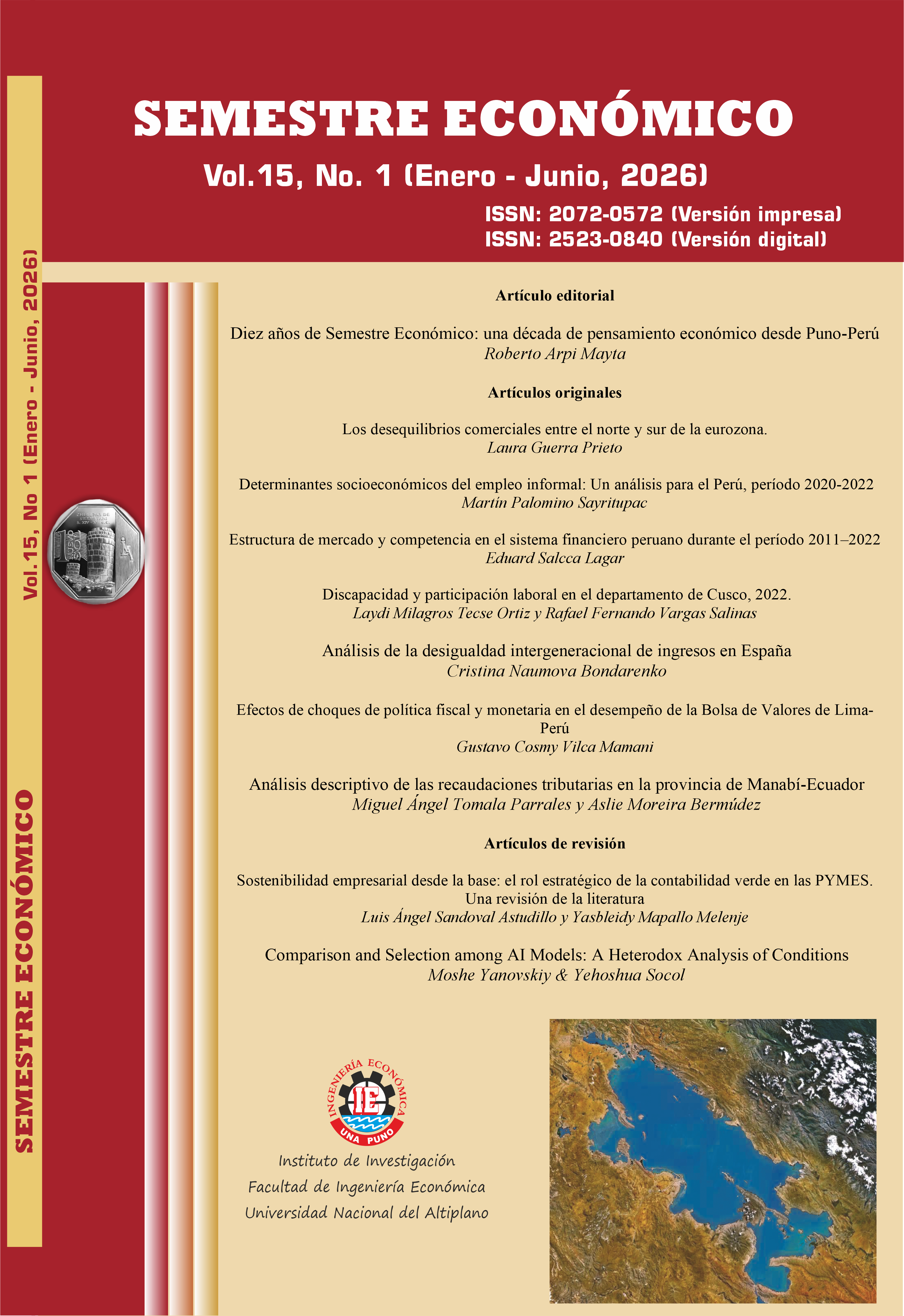
Effects of Fiscal and Monetary Policy Shocks on the Performance of the Lima Stock Exchange
DOI:
https://doi.org/10.26867/se.2026.v15i1.202Keywords:
Fiscal policy, Monetary policy, Stock market, VECMAbstract
The behavior of the stock market is regarded in many economies as a key indicator of economic activity. In light of past crises, it is crucial to assess whether the measures implemented by the government or by institutions responsible for maintaining economic stability were appropriate. Therefore, this study analyzes the effects of fiscal and monetary policy on the performance of the Lima Stock Exchange over the period 2003–2023. The research adopts a quantitative approach, with an explanatory scope and a non-experimental longitudinal design. Monthly frequency data were used, and the variables analyzed include public expenditure, taxes, the policy interest rate, and the general index of the Lima Stock Exchange. Regarding the estimations, a Vector Autoregressive (VAR) econometric model was employed, with a focus on Impulse Response Functions (IRFs). The results indicate that fiscal policy—through increases in public spending and taxation—has a negative impact on the general index of the Lima Stock Exchange. Similarly, the policy interest rate of the monetary authority also exerts a negative effect. It is concluded that these policies influence the performance of the Lima Stock Exchange in the short term.
References
Afonso, A., & Sousa, R. M. (2011). What are the effects of fiscal policy on asset markets? Economic Modelling, 28(4), 1871–1890. https://doi.org/10.1016/j.econmod.2011.03.018
Agnello, L., & Sousa, R. M. (2013). Fiscal policy and asset prices. Bulletin of Economic Research, 65(2), 154–177. https://doi.org/10.1111/j.0307-3378.2011.00420.x
André, C., Caraiani, P., & Gupta, R. (2023). Fiscal policy and stock markets at the effective lower bound. Finance Research Letters, 58. https://doi.org/10.1016/j.frl.2023.104564
Banco Central de Reserva del Perú. (2024). Series estadísticas. Banco Central de Reserva del Perú. https://estadisticas.bcrp.gob.pe/ b.pe/estadisticas/series/
Blanchard, O. J. (1981). Output, the Stock Market, and Interest Rates. The American Economic Review, 71(1), 132–143.
BUI, D. T., LLORCA, M., & BUI, T. M. H. (2017). Dynamics between stock market movements and fiscal policy: Empirical evidence from emerging Asian economies. Pacific Basin Finance Journal, 51, 65–74. https://doi.org/10.1016/j.pacfin.2018.05.010
Census Bureau. (2024). X-13ARIMA-SEATS Seasonal Adjustment Program. Census Bureau. https://www.census.gov/data/software/x13as.html
Chatziantoniou, I., Duffy, D., & Filis, G. (2013). Stock market response to monetary and fiscal policy shocks: Multi-country evidence. Economic Modelling, 30(1), 754–769. https://doi.org/10.1016/j.econmod.2012.10.00 5
Cortés, M. E., & Iglesias, M. (2004). Generalidades sobre Metodología de la Investigación (Primera edición). Universidad Autónoma del Carmen.
Fama, E. F., & French, K. R. (1989). Business Conditions and Expected Returns on Stocks and Bonds. Journal of Financial Economics, 25, 23–49.
Hamilton, J. D. (1994). Time Series Analysis. Princeton University Press.
Hernández Sampieri, R., Fernández Collado, C., & Baptista Lucio, M. del P. (2014). Metodología de la Investigación (McGraw-Hill, Ed.; Sexta edicion).
Isola Lawal, A., Olukayode Somoye, R., Ayoopo Babajide, A., & Ikechukwu Nwanji, T. (2018). The effect of fiscal and monetary policy interaction on stock market performance: Evidence from Nigeria. Future Business Journal, 4(1), 16–33. https://doi.org/10.1016/j.fbj.2017.11.004
Jensen, G. R., & Johnson, R. R. (1995). Discount rate changes and security return in the US, 1962-1991. Journal of Banking & Finance, 19, 79–95.
Lütkepohl, H. (2005). New Introduction to Multiple Time Series Analysis. Springer.
Lütkepohl, H., & Krätzig, M. (2004). Applied Time Series Econometrics. Cambridge University Press.
Marfatia, H. A., Gupta, R., & Miller, S. (2020). 125 Years of time-varying effects of fiscal policy on financial markets. International Review of Economics and Finance, 70, 303–320. https://doi.org/10.1016/j.iref.2020.07.011
Montasser, G. El, Gupta, R., Charl, J., & Miller, S. M. (2020). The Time-series Linkages between US Fiscal Policy and Asset Prices. Public Finance Review, 48(3), 303–339. https://doi.org/10.1177/1091142120916032
Morgan Stanley Capital International. (2024). Market Classification Consultations. Morgan Stanley Capital International. https://www.msci.com/our-solutions/indexes/market-classification
Mumtaz, H., & Theodoridis, K. (2020). Fiscal policy shocks and stock prices in the United States. European Economic Review, 129. https://doi.org/10.1016/j.euroecorev.2020.103562
Nelson, C. R., & Plosser, C. I. (1982). Trends and Random Walks in Macroeconomic Time Series: Some Evidence and Implications. Journal of Monetary Economics, North-Holland Publishing Company.
Phillips, P. C. B., & Perron, P. (1988). Testing for a unit root in time series regression. Biometrika, 75(2), 335–346. https://doi.org/10.1093/biomet/75.2.335
Rahman, M., & Mustafa, M. (2017). Financial deepening and stock market returns: Panel data analyses for selected developed and developing economies. International Journal of Monetary Economics and Finance, 10(1), 96–109. https://doi.org/10.1504/IJMEF.2017.081287
Tavares, J., & Valkanov, R. (2003). The Neglected Effect of Fiscal Policy on Stock and Bond Returns *. http://www.personal.anderson.ucla.edu/rossen.valkanov/page1.htm
Tobin, J. (1969). A General Equilibrium Approach to Monetary Theory. Journal of Money, Credit and Banking, Vol. 1, No. 1 (Feb., 1969). http://about.jstor.org/terms
Tong Chang, J. J. (2013). Fondos mutuos en el Perú: desarrollo e impacto en el mercado de valores. Universidad Del Pacífico.
Downloads
Published
Issue
Section
License
Copyright (c) 2026 Gustavo Cosmy Vilca Mamani

This work is licensed under a Creative Commons Attribution 4.0 International License.